INNOVACIÓN

Nuevas propuestas para los nuevos desafíos.

NEGOCIO

Nuevos caminos, nuevas oportunidades.

SOBRE NOSOTROS

De nuestros orígenes en la UPM a nuestras aventuras como ingenieros

Mostrando entradas con la etiqueta Procesos. Mostrar todas las entradas

lunes, 17 de noviembre de 2014

Desalación del petróleo


En el capítulo anterior di una imagen muy simplificada de una refinería, la cual se podría resumir en como una corriente de petróleo crudo entraba, tras unos preparativos, en una gigantesca columna de destilación donde obteníamos diferentes salidas, cada una de las cuales tras pasar por diferentes unidades y procesos más o menos laboriosos obteníamos productos como la gasolina, asfalto, keroseno...etc.

El artículo de hoy se centra en un proceso previo clave, como es la desalación del petróleo. Y es que la propia palabra “petróleo” proviene del griego y significa “aceite de roca”. No esperamos que algo que lleva millones de años en las profundidades de la tierra salga brillante e impoluto. A nuestra refinería no nos llega una mezcla perfecta de hidrocarburos, sino que presenta una gran cantidad de impurezas. Estás son en su mayoría sales, como cloruros de sodio y magnesio.

Estos compuestos podrían cristalizar en los intercambiadores de calor o lo que es peor, dentro de la propia columna, e incluso dadas las altas temperaturas con las que se trabajan podrían llegar a hidrolizarse produciendo ácidos (cómo el ácido clorhídrico) que podrían dañar seriamente los equipos.

En este paso también se tiene que acabar con otro tipo de impurezas, que aunque secundarias en comparación con las sales, también nos pueden crear más de un quebradero de cabeza aguas abajo, como son las arenas finas, arcillas, óxidos y sulfuros de hierro, incluso partículas que hayan podido contaminar el crudo durante el proceso de extracción y transporte.

Todo esto lo llevamos a cabo mediante un proceso de extracción con agua dulce, llevada a cabo en enormes decantadores. Hay que tener en cuenta que toda la (inmensa) alimentación a la refinería tiene que pasar si o si por aquí, así que en consecuencia tendremos equipos enormes y grandes gastos de agua.


Primero se forma una emulsión, con el objetivo de crear una gran superficie de interfase para facilitar la transferencia de sal, para finalmente separar agua y petróleo desalado aprovechando su diferencia de densidad en un decantador.

Debido a la alta viscosidad de la fase orgánica la decantación suele llevarse a cabo a temperaturas del orden de 120-150ºC y a presión suficiente para evitar la vaporización del agua y de los gases volátiles del petróleo. La ruptura de la emulsión se facilita mediante aditivos químicos tales como la sosa cáustica, que disminuyen la tensión superficial y varían el pH.

El decantador está equipado con unos deflectores dispuestos convenientemente para evitar turbulencias y caminos preferenciales, saliendo el crudo desalado, menos denso, por la parte superior, y el agua salada por la inferior, después de un tiempo medio de residencia de 40-60 minutos. Para acelerar la coalescencia se suelen emplear campos eléctricos de elevado potencial (16-35 KV). El control de la separación de las fases crudo-agua se lleva a cabo mediante conductividad, ya que el agua conduce mucho mejor que el crudo.

La eficiencia típica de procesos con un decantador son del 90-95%, habitualmente pasando de valores de 0,2-0,4 kg/m3 de sales a 0,02-0,04 kg/m3. Sin embargo, lo típico es emplear dos decantadores a contracorriente, llegando a eficiencias del 99%. La separación de sólidos en suspensión debería ser del 60% o mayor, llegando a separarse el 80% de las partículas mayores de 0,8 micras.

Las aguas aceitosas y salinas que obtenemos presentan un elevado pH y un gran contenido de materia sólida en suspensión, por lo que se suelen tratar separadamente de otras aguas residuales de refinería.


El coste de estas unidades no es tan grande comparado con el daño que los elementos que separan pueden ocasionar en los equipos de la refinería aguas abajo.

Bibliografía:
  • ·         Apuntes de la asignatura “refino de petróleo y petroquímica”, Angel Santos.
  • ·         “Refino de petróleo, gas natural y petroquímica”, Miguel Ángel Ramos Carpio, 1997
  • ·        “Petroleum refining, technology and economics”, 4th edition James H.Gary, Glen E.Handwerk

lunes, 10 de noviembre de 2014

Refino de petróleo para dummies

Antes de empezar, quisiera recalcar que este artículo está destinado principalmente a los estudiantes, ya que posiblemente muchos de los profesionales de la ingeniería química que lean esto pensarán que es una perogrullada.

Ahora recuerdo mi primera clase de operaciones de separación, cuando el profesor nos transmitió de manera rápida y esquemática, en apenas una clase, la idea principal de lo que es una refinería de petróleo. Y es que a este tipo de procesos los englobaría en lo que denomino como “culturilla general” de un ingeniero químico.

Por esa razón, aunque el petróleo no sea de tu gusto y no sea la especialidad que escojas, siempre viene bien saber un poco del tema. Más aun teniendo en cuenta que es un sector que mueve miles de millones anualmente, en el que trabajan miles de ingenieros químicos, tanto directa como indirectamente.
Una vez hecha la aclaración, comenzamos:

¿Qué es una refinería?
Lo podríamos definir como una plataforma industrial de gran tamaño destinada a la refinación del petróleo, mediante el cual se obtienen diversos combustibles fósiles, cómo la gasolina y el gasóleo y otros productos de interés (aceites, keroseno, asfaltos...etc).
Y es que si del cerdo se aprovechan hasta los andares, con el petróleo pasa lo mismo. La sustancia oscura que metemos se puede convertir en un sinfín de productos que son esenciales para la vida del hombre actual.
Estas instalaciones también se caracterizan por el consumo de cantidades ingentes de electricidad, por lo que su optimización energética es de principal importancia. Los productos principales que se obtienen son la gasolina y el gasóleo, y la unidad de volumen más empleada es el barril. Por cierto, un barril son aproximadamente 159 litros (¿os acordáis cuando decía lo de la “culturilla”...?)

El esquema de proceso básico de una refinería es el siguiente:


El Crudo con el que alimentamos el proceso primero pasa por un proceso de desalado, en el que pierde mayoritariamente cloruro sódico, para someterlo a una destilación atmosférica en una columna de destilación de grandes proporciones.
Estas columnas se alimentan en continuo por su parte inferior con el crudo previamente calentado de 375ºC mediante un horno, siendo vital que no supere los 400ºC para evitar reacciones de cracking, que (ahora) no nos interesan.
En la columna se van realizando sucesivas extracciones laterales correspondientes a las distintas fracciones destiladas. La fracción más ligera se obtiene por cabeza está completamente vaporizada, una parte de la cual después de condensar se reintroduce como reflujo en la columna.
Las extracciones laterales son líquidos saturados que se someten a agotamiento en strippers laterales, generalmente mediante arrastre con vapor. La parte más pesada de la alimentación que no llega a destilar se denomina residuo atmosférico o crudo reducido, que también se somete a stripping con vapor para arrastrar los ligeros que lleva disueltos consigo.

Es importante resaltar que no existen dos refinerías iguales de la misma forma que no existen dos crudos iguales. No es lo mismo tratar un crudo arábigo, más ligero, que uno azteca, por ejemplo. El crudo es de mayor calidad cuanto más ligero es.
Además, esta es solo una imagen extremadamente simplificada de la red intricada de procesos que se llevan a cabo en una refinería. Hay que tener en cuenta que cada corriente (ligeros, naftas, crudo reducido...etc) tiene luego su propio proceso asociado, en el que se separan más componentes, se producen reacciones, se refina el producto final...etc.


Esto nos da una idea de las elefantiásicas proporciones de estas instalaciones, de su complejidad y del ingente coste energético que lleva asociado el llevar todas estas operaciones a buen puerto. 

Antonio Montero Andrés

domingo, 26 de octubre de 2014

El glicerol como problema


Este trialcohol, también conocido por el nombre de glicerina, es hoy el producto clave económicamente hablando para las biorefinerías de biodiesel. Y desde luego no deja de ser sorprendente como un producto con tantas cualidades pueda llegar a ser un quebradero de cabeza para estas industrias a día de hoy.
En efecto, la glicerina puede usarse como disolvente, como excipiente, como antiséptico... muy empleado en la industria de los cosméticos y en la industria farmacéutica. Lo mismo te vale para fabricar explosivos como la nitroglicerina que como anticongelante. Y como guinda del pastel, no es tóxico.

Entonces, ¿Cuál es el problema?

Pues todo surge a raíz de la producción de biodiesel. Con el objetivo de conseguir menor dependencia de los combustibles fósiles, la producción de biocombustibles ha ido en aumento, y de la mano, la producción de glicerol. 

La reacción de transesterificación, que es la fundamental para la obtención de biodiesel, es la siguiente:


Es decir, transformamos los triglicéridos de la materia prima en ésteres de ácidos grasos, generando al mismo tiempo glicerol.

Como promedio, obtenemos 1 kg de glicerina por cada 10 kg de biodiesel. Claro está, que este factor dependerá del tipo de aceite que metamos en el sistema. (1). Anteriormente, la industria del jabón, que también obtenía como subproducto la glicerina, era la que sustentaba la demanda de este producto, dejando la aportación de las biorefinerías un papel testimonial. Sin embargo, gracias entre otras cosas a las nuevas directivas europeas que imponen un porcentaje de biocombustible en los carburantes tradicionales, han disparado la producción de glicerina de tal forma que el mercado mundial se ha saturado.

Debido a esta abundancia de glicerina, su precio ha bajado considerablemente, lo que ha convertido un desecho de producción relativamente atractivo en algo de escaso valor, hasta tal punto que una de las alternativas que se están tomando es valorizar estos excedentes para aportar energía a la planta.


Por lo tanto, la mayor parte de los esfuerzos en materia de I+D+i de estas empresas  es buscar una alternativa que de un valor añadido a estos “residuos”.

Se están estudiando varias alternativas, y me ha llamado la atención la reciente investigación llevada a cabo por la Universidad de Salamanca y Centro de Investigación de Polímeros Avanzados de Chile (CIPE), en los que han conseguido sintetizar dos tipos de polímeros: uno líquido y otro sólido. (2)

Según Claudio Toro, director ejecutivo de CIPA, el polímero líquido se podría utilizar para la formulación de pinturas y poliuretanos, mientras que el polímero en estado sólido se podría emplear como adsorbente para la purificación de aceites.

El equipo ha usado estos datos experimentales para simular un proceso industrial con el objetivo de realizar una evaluación técnica y económica. Los resultados se publican en la revista Chemical Engineering Research and Design y forman parte del proyecto fin de carrera de la investigadora Laura Bueno.

De momento estamos hablando de trabajo de laboratorio, aunque el equipo de investigadores no descarta llevarlo a planta piloto.


(2)             http://www.agenciasinc.es/Noticias/Como-transformar-el-glicerol-en-polimeros-de-interes-comercial

Antonio Montero Andrés

miércoles, 15 de octubre de 2014

Steps in the production process of Lube oils.


The production process of lubricants comprises several steps. The main steps will be described below.

  •        Atmospheric distillation:
In this first step the oil is heated to 400 ° C in a furnace. A mixture of gases and liquids is then produced, which passes to the fractionation tower or condenser. The gases condense in the column and are collected at different heights depending on the different boiling points. These are the raw materials for the manufacture of various types of fuels.
The liquid residue from the first distillation, which is in the bottom of the distillation column is the raw material for the manufacture of lubricant oils.


Figure 1. Atmospheric distillation.

  • Vacuum distillation:

The liquid residue obtained is subjected to a second distillation, which takes place under reduced pressure (vacuum distillation) and separated into several fractions.
The more volatile fraction is used as fuel.
The residue is used for the production of heavy oils and asphalts.
The intermediate fractions are used for the production of base oils for the manufacture of lubricant oils. Up to four fractions of base oils can be produced.


Figure 2. Vacuumm distillation.

  •  Deasphalting

The less volatile fraction of the base oils contains large amounts of asphaltenes. These compounds are removed by deasphalting. In this step t the oil is blended with propane, which is capable of solving most of the asphaltenes and these can be separated afterwards.


                                                                          Figure 3. Deasphalting process.

  • Solvent extraction

In this operation the base oil is blended with solvents that have the ability to dissolve aromatics. Alkanes and cycloalkanes are not solved and can be separated subsequently. The product of this stage has a higher viscosity index and is more stable to oxidation than the previous base oil.


Figure 4. Solvent extraction.

  •  Dewaxing

The next step is the dewaxing, where  the alkanes with high melting point are removed  and oil properties at low temperature are improved. The conventional technique involves blending the oil with a suitable solvent and then the mixture is cooled. The wax solidifies and it is separated by filtering the oil. Alternatively, the catalytic dewaxing can take place, in which the molecular structure of the alkanes is altered by treatment with hydrogen in the presence of a catalyst.


                                                                              Figure 5. Dewaxing process.

  • Hydrogenation

Hydrogenation  is used for oils where the aromatic and asphaltene content must be further reduced. In this process the oil is treated under pressure with hydrogen in the presence of a catalyst.


Finally the refined base oil is ready to be blended with other base oils and reinforced with additives for the production of different types of lubricating oils.


Author: Silvia Fernández Castejón. Chemical Engineer. Complutense University of Madrid.

Bibliography:

Introducción a los lubricantes y la lubricación. Tutorial de lubricación Shell.
https://es.scribd.com/doc/18198822/10/LA-FABRICACION-DE-ACEITES-LUBRICANTES

martes, 14 de octubre de 2014

Principles of Free-Radical Polymerization Kinetics


In order for polymerization to take place, we have seen that the monomer has to have double functionality. In step growth polymerization this was provided by the co-reactive functional groups of the monomers. In free radical polymerization the opening of a double bond provides this functionality. The organic molecule reacts with an active species as follows:

Therefore, primary free radicals must be introduced to start the reaction. This is done by the use of an initiator, a thermo-labile compound, typically peroxides or azo-compounds which decompose in the following way:
The primary radicals react with the monomer producing monomer radicals:
Where f is the initiator efficiency or the fraction of radicals that are captured by monomer molecules. From this point, the site of the reactive center changes by the propagation (addition or transfer) reactions:
The rate of addition is not affected by the size of the organic macro-radical, therefore the rate of propagation can be expressed as:

In free radical polymerization, long chains of polymer are formed for a low monomer conversion, since the time life of free radicals is very small.

Chain transfer reactions can occur by transfer of an atom to the macro-radical. The macro-radical is terminated and the new active species can a) add more monomer b) terminate without further addition (inhibition). In any case, the result of chain transfer reactions is a lower molecular weight of the polymer. Schematically, the reaction is shown below:
Transfer reactions may take place from macro-radical to monomer, initiator, solvent or to an agent intentionally introduced to control MW. Only transfer to monomer cannot be controlled and determines the maximum degree of polymerization. The transfer constant is the ratio between the kinetic rates of the transfer reaction with respect to the propagation, where i depends of the nature of the transfer reaction:
The successive addition reactions terminate when two radicals encounter each other. This termination can take place by combination or disproportionation of the two radicals:


It is noteworthy that the termination coefficient is highly dependent on diffusion of the macro-radicals, and when these become entangled with the polymer chains, kt values decrease significantly, leading to auto-acceleration of polymerization for high monomer concentrations due to lower termination and higher propagation rates (see below).

In order to determine the molecular weight in free radical polymerization, we must calculate the ratio between the depletion of monomer with respect to the production of polymer. For relatively high molecular weight products, the initiation rate is negligible compared to the propagation. If we take the inverse of this ratio:

We obtain the Mayo equation. If we assume the transfer reaction negligible when compared to the termination reactions, and a steady state is reached, the initiation rate is equal to the termination rate. The concentration of radicals can be therefore calculated and introduced in the Mayo equation to determine the degree of polymerization:
We observe that the propagation rate is proportional to kp and inversely proportional to kt1/2 in steady state conditions.
Carlos Arnaiz del Pozo

This summary was elaborated from the outcomes of the course ‘’Polymer Reaction Engineering’’ in the TU/e for the PPD Designers program and from the book: Elements of Polymer Science and Engineering. A.Rudin.

miércoles, 1 de octubre de 2014

Jatropha oil, an alternative raw material for the production of biodiesel. Analysis of the pretreatment process.


As an alternative fuel, biodiesel must compete economically with conventional fuels. One way to reduce costs is to use less expensive feedstocks such as non-edible oils, animal fats, waste cooking oil and by-products of vegetable oil refining. Non-edible vegetable oils, mostly from seeds of trees and shrubs, can be a good alternative. Within them it is Jatropha oil.
Jatropha oil is toxic. Therefore, it has the advantage of not being edible and thus not competing with other uses like other oils that may be intended for human or animal consumption. However, it has the disadvantage of having a high content of free fatty acids (FFA). This requires a special pretreatment process to be used as a feedstock in the biodiesel production process.
The biodiesel production process consists of the following steps:


Graphic 1. Steps in the production process in the chemical industry. Biodiesel production process.

Starting with the oil, it is necessary to perform several pretreatment steps in order to obtain a raw material which fulfills the specifications for been used in the production of biodiesel. Graphic 2 shows the general steps of the pretreatment process of a crude oil in the biodiesel production process.

Graphic 1. Pretreatment process of an oil as raw material for the biodiesel production process.

Making an analysis of pretreatment steps in the particular case of Jatropha oil, we conclude the following:

Degumming: Vegetable oils often contain gums such as phospholipids. These substances deactivate the transesterification catalyst, due to its content in phosphorus. The purpose of degumming is removing these gums.
In this case, the effect of the phospholipids in the esterification reaction has been investigated by adding them to the oil after the degumming or the refining step. Phospholipids were shown to show little influence on the final conversion of free fatty acids in the esterification. It can be concluded that in this particular case this step is not necessary.

Neutralization. Due to the high FFA content (up to 40% by weight) in Jatropha oil, its elimination would not be advisable, since raw material is lost. The best option would be one of the proposals for raw materials with high content in AGL. The literature consulted showed that the most common method for reducing the FFA content is acid catalysis or esterification.

Deodorization and bleaching: Because the goal of the process is to produce biodiesel, these operations will not be performed, since it is only recommended in the case of  oils for human consumption.

Washing and drying: The two stages are necessary in all oils pretreatment, being of great importance drying due to the influence of the water on the kinetics of the transesterification reaction.
It is concluded that the pretreatment process for Jatropha oil case consists of the following phases:

Graphic 3. Steps of the pretreatment process for the Jatropha oil in the biodiesel production process


The esterification reaction
An AGL reversibly reacts with an alcohol in the presence of an acid catalyst to form ester and water. FFA by this reaction may be transformed into esters. The reaction product contains less amount of FFA and after separation of the water, can be used as an economical raw material for the transesterification.

Graphic 4. Esterification reaction using sulphuric acid as a catalyst.

Secondary reactions
FFA reactive with the basic catalysts of the transesterification  reaction (NaOH or KOH) to form soap (saponification reaction).

 Graphic 5. Saponification reaction of FFA in the presence of the transesterification catalyst.

Furthermore, the presence of moisture results in the hydrolysis of the triglycerides present in the oil, that should give AGL esters as a result and dilute the acid catalyst so that the reaction rate decreases. Being a reversible reaction, the presence of water, a reaction product, influences the conversion and the reaction rate.

Free fatty acids
The FFA content in Jatropha oil may exceed 40 % wt, above the values ​​for a desirable feedstock for transesterification, being recommended less than 0.5 % wt.

Alcohols
At this stage the most widely used alcohols are methanol and ethanol, being the first more widely used.

Catalysts
The esterification reaction does not occur in the absence of catalyst. The catalyst is acid and the catalysis may be:

 Homogeneous catalysis: with catalysts such as sulfuric, hydrochloric, sulphonic and phosphorus acids,  being the first the most used.

 Heterogeneous Catalysis: various solid acid catalysts have been studied such as D72 resin HM molecular sieve, SAPO-11, HZSM-5, H.beta and metatitanic acid (SO 4 2 / TiO 2), showing the latter a higher activity in the reaction .

Conditions of the esterification reaction
Doing a research, the usual conditions of the esterification reaction are shown in the following table:

 Table 1. Usual Conditions in the esterification reaction.

Units
Range
METANOL PURITY
% wt.
98 - 99,8
CATALYST PURITY (H2SO4)
% wt.
98 - 99
PRESSURE
atm
1
TEMPERATURE
ºC
30-60
TIME
min
60-120
CATALYST CONCENTRATION
% wt.
1-10
METHANOL / OIL RATIO
v/v
0,16-12


Author: Silvia Fernández Castejón. Chemical Engineer. Complutense University of Madrid.

Bibliography:
- H.J. Berchmans, S. Hirata. Biodiesel production from crude Jatropha curcas L. seed oil
with a high content of free fatty acids. Bioresource Technology 99 (2008) 1716 – 1721
- M. Berrios y col. A kinetic study of the esterification of free fatty acids (FFA) in
sunflower oil. Fuel 86 (2009) 2383 - 2388
- W.M.J. Achen y col. Review. Jatropha bio-diesel production and use. Biomass and
bioenergy 32 (2008) 1063 – 1084
- E.Santacesaria y col. Comparison of different reactor configurations for the reduction
of free acidity in raw materials for biodiesel production.Ind.Eng.Chem.Res.2007, 46,
8355-8362.


domingo, 31 de agosto de 2014

Basics of Batch Emulsion Polymerization

In emulsion polymerization, a dispersion of polymer in aqueous phase (latex) is obtained. The solids content is usually between 40-65 %w. These polymers are broadly used in paints, adhesives, rubbers, binders and additives for the paper and textile industry. The development of reliable mathematical models for emulsion polymerization requires a high level of understanding of the phenomena taking place in the reactor. In this article, we offer a brief overview of the basic steps in batch emulsion polymerization and we discuss the kinetics of the process. Common monomers employed in this polymerization are styrene, methyl methacrylate or vinyl acetate.

The monomer feed is dispersed using water emulsifiers or surfactants. These are typically molecules like Sodium Lauryl Sulfate with a non-polar tail and a water soluble end which stabilize the monomer droplets in the aqueous phase. The excess of surfactant forms micelles which are swollen with monomer, as it is described in the following figure:


Polymerization is started by means of a water soluble initiator (tert-butyl hydroperoxide, potassium persulfate). Thus radicals are formed in the aqueous phase from the small amount of monomer dissolved. When the oligoradical chain has grown to a certain extent, it becomes hydrophobic and enters one of the micelles (the entry to the monomer droplets is unlikely because of the low total surface area that these represent). This is called heterogeneous nucleation and as a result a polymer particle is formed. If the oligoradical does not enter a micelle, it will continue growing until it precipitates absorbing emulsifier (homogeneous nucleation). This situation is described in the following figure:


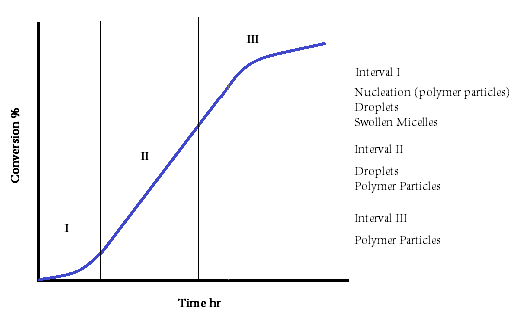
In this stage there is a coexistence of monomer droplets, monomer swollen micelles and polymer particles in the reactor. Monomer is consumed inside the polymer particles according to the free radical polymerization mechanisms. The monomer consumed is replaced by monomer that diffuses from the droplets. The micelles in the system decrease because they are converted to polymer particles or they are destroyed to provide enough surfactant to the growing polymer particles. When all the micelles disappear (5-10% of monomer conversion), the nucleation interval has come to an end:


At this stage, the system consists of polymer particles and monomer droplets. Given that the mass transfer rate for monomers with higher water solubility than styrene is higher than the polymerization rate, the monomer concentration in the polymer particles reaches a maximum and constant value. When solubility is too low, this stage can be diffusionally limited.

As monomer diffuses from droplets to particles, these grow until the monomer droplets disappear. At this point the system is exclusively composed of polymer particles. The monomer conversion at which this takes place highly depends on the capacity of the particles to be swollen with monomer (40% for styrene, 15% for vinyl acetate). In this new interval the monomer concentration is the particles decreases until polymerization is completed. Finally, polymer particles in a latex of size varying from 80-300nm are obtained:


These stages are summarized in the following conversion-time figure:


The rate of polymerization in the polymer particles is similar to the bulk polymerizations, where kp is the propagation constant [m3 mol-1 s-1], [M]p is the monomer concentration in the polymer particles, n is the average number of radicals per particle, Np the number of polymer particles and NA the Avogadro’s number:

Since in emulsion polymerization the radicals are distributed among the particles, the overall radical concentration is much higher than in bulk polymerization, resulting in a higher polymerization rate. Radicals have a longer life time leading to higher molecular weights, and are not terminated until another radical enters the particle, which is less probable if there are more polymer particles in the system. Therefore, the polymerization rate and the molecular weight can be increased simultaneously by increasing the number of particles. This is an advantageous characteristic of emulsion polymerization that could not be attained in bulk or solution polymerization.


Carlos Arnaiz del Pozo